Mark Your Calendars: A Half-Century of Environmental Deadlines That the Planet Rudely Ignored
There is a particular kind of prediction that is worse than being wrong. It is the prediction that comes with a date attached — a specific, calendared, circle-it-in-red deadline after which, the prophet assures us, the point of no return will have passed, the die will have been cast, and the consequences will be both irreversible and entirely our fault for not listening.
Environmental prophecy has specialized in exactly this kind of prediction for fifty years. And the ledger of missed deadlines is, at this point, long enough to require its own index.
This is not an argument that the environment is fine. It is not a brief for complacency or a dismissal of ecological science. It is something more uncomfortable: an honest look at what happens when legitimate concern gets dressed up in apocalyptic costume and sent out to meet the public with a specific expiration date stamped on its forehead.
The First Wave: When 1980 Was Going to Be the End
The modern era of environmental deadline-setting began in earnest with the ecology movement of the late 1960s and early 1970s, a period that produced some of the most confidently wrong predictions in the history of futurism.
Paul Ehrlich, a Stanford biologist whose 1968 book The Population Bomb sold millions of copies and influenced a generation of environmentalists, was particularly productive in this regard. By the mid-1970s, he had predicted, in various forums, that hundreds of millions of people would starve to death in the 1970s, that England would not exist as a going concern by the year 2000, and that the life expectancy of Americans would drop to 42 years by 1980.
By 1980, England was still there, Americans were living longer than ever, and global food production had expanded dramatically thanks to the Green Revolution — a development Ehrlich had not factored into his models. The predictions were not quietly retired. They were simply replaced with new ones, featuring updated dates.
This, too, became a tradition.
The Whale That Refused to Go Extinct on Schedule
No animal has been more frequently, more confidently, and more prematurely scheduled for extinction than the great whale. Beginning in the 1960s, environmental groups — with considerable justification, given the genuine devastation of commercial whaling — began issuing predictions that several whale species would be extinct within a decade.
The International Whaling Commission instituted a moratorium on commercial whaling in 1986, which was unambiguously a good thing. But the extinction timelines that preceded it, specific and urgent as they were, did not come to pass. Humpback whale populations, declared functionally doomed by multiple sources in the 1970s, have recovered substantially. Blue whale populations remain critically low, but the species is alive — a fact that represents genuine conservation success, not the inevitable extinction that was confidently scheduled for sometime around 1990.
The prophets, to their credit, helped generate the political will for the moratorium. The prophecies, to their discredit, were wrong. These two things are both true, and the relationship between them is more complicated than either the prophets or their critics like to admit.
The Acid Rain Apocalypse That Mostly Didn't Happen
The 1980s brought acid rain to the center of American environmental anxiety, and with it a new set of calendared catastrophes. Forests across the Northeast and upper Midwest were dying, and they were going to keep dying. By the early 1990s, according to predictions made with considerable confidence in the early 1980s, significant portions of the Adirondacks and the Appalachians would be ecologically devastated, their lakes turned to dilute sulfuric acid, their trees stripped bare.
Congress passed amendments to the Clean Air Act in 1990 that dramatically reduced sulfur dioxide emissions. Acid rain declined. The forests, while damaged, did not undergo the predicted catastrophic collapse. This was, by any reasonable measure, a policy success story — and one that the most dire predictions had not accounted for, because the most dire predictions generally don't.
The lesson, if there is one, is that "this will happen if we do nothing" is a fundamentally different prediction from "this will happen." The former is often correct. The latter, when it carries a specific date and assumes total human paralysis, has a considerably spottier track record.
The Tipping Point That Keeps Getting Tipped
Climate change has produced, over the past three decades, a remarkable number of specific deadlines, each of which has arrived and departed without the promised point of no return materializing in the form advertised.
In 2007, a senior United Nations official warned that humanity had perhaps eight years to avoid the worst consequences of climate change. Eight years later, the world was warmer, emissions were higher, and the conversation had shifted to a new deadline, equally urgent, equally specific. In 2009, a prominent climate scientist suggested that President Obama had four years to save the planet. The four years passed. New deadlines were issued.
None of this means climate change isn't happening, because it is. The scientific consensus on the basic physics of greenhouse gases has not changed and is not seriously disputed by anyone who has looked at the data honestly. What has been serially wrong is not the underlying science but the specific, dated, all-or-nothing framing that advocates have repeatedly layered on top of it.
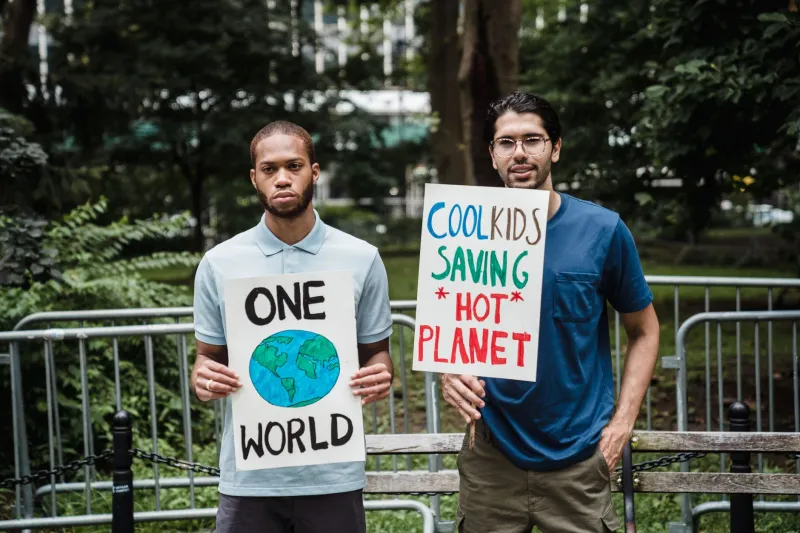
The planet, it turns out, does not warm in neat deadline-shaped increments. The consequences of emissions accumulate gradually, non-linearly, and in ways that resist the kind of before-and-after narrative that makes for a compelling magazine cover. "Things are getting measurably worse in ways that will compound over decades" is accurate but does not fit on a protest sign as neatly as "12 Years to Save the Planet."
The Credibility Problem Nobody Wants to Talk About
Here is the uncomfortable question that the history of environmental deadline-setting forces us to confront: what happens to the warning system when the warnings have a documented track record of crying wolf on the timeline, even when they're right about the direction?
Research on risk communication suggests that specific, falsifiable predictions that fail tend to erode public trust more than vague warnings — even when the underlying concern is legitimate. The boy who cried wolf was not wrong that wolves existed. He was wrong about the specific wolf, on the specific day, at the specific time. And the villagers, having been burned before, were understandably less responsive when the actual wolf arrived.
Environmental advocates have grappled with this problem without fully resolving it. The urgency is real. The political system responds to urgency. Specific deadlines create urgency. But specific deadlines that pass without the predicted catastrophe also create ammunition for those who prefer to do nothing, and that ammunition has been used, enthusiastically and repeatedly, by people who are not arguing in good faith.
What the Prophets Got Right, Eventually
The fairest accounting of fifty years of environmental prophecy is this: the direction was almost always correct, the mechanisms were usually sound, and the timelines were almost always wrong in ways that alternated between too pessimistic and too optimistic, depending on whether human ingenuity or human stubbornness happened to be winning that particular decade.
The ozone layer was genuinely in serious trouble. The Montreal Protocol fixed it. The prophets who warned about it were right about the problem and wrong to assume the problem would be ignored. Acid rain was a genuine threat. Legislation reduced it. The prophets were right about the chemistry and wrong about the political paralysis.
Climate change is the current entry in this ledger, and it is too early to know which column it ultimately belongs in. The physics are not in dispute. The specific deadlines are, by now, a running joke that the movement's own members acknowledge, at least privately, has cost them something.
The planet, for its part, has not scheduled a press conference to clarify its intentions. It just keeps doing what it does — warming, changing, occasionally defying the specific predictions made about it — while the prophets recalibrate, reissue, and try again.
The next deadline is probably already circled on someone's calendar. We'll check back when it arrives.