The Highway to Nowhere: A Century of Experts Who Were Absolutely Certain You'd Stop Sitting in Traffic
In 1939, General Motors built a scale model of America's future transportation system at the World's Fair in New York. It was called Futurama, and it depicted a gleaming 1960 in which superhighways whisked citizens between cities at 100 miles per hour, traffic flowed with serene efficiency, and congestion was a solved problem. Fifty million people stood in line to see it. General Motors was selling cars, obviously, but the vision was sincere: technology and planning would make the commute painless.
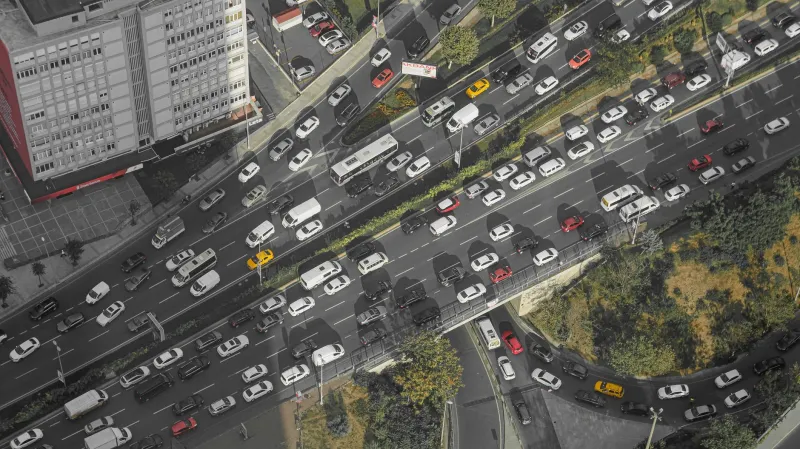
It is now several decades past 1960. The average American commuter spends approximately 27 minutes each way getting to work, a number that has increased steadily since the 1980s. In major metropolitan areas, it is considerably worse. Los Angeles, which the Futurama model essentially predicted would be a paradise of smooth-flowing traffic, has been ranked among the most congested cities on earth so many times the local newspapers have stopped treating it as news.
The prophecy has been updated many times since 1939. The specific technology changes. The confidence does not.
The Telecommuting Revolution: Always Five Years Out
The first serious wave of commute-elimination prophecy arrived not with a new road but with a new wire. In the early 1970s, as the oil embargo made Americans suddenly conscious of how far they were driving, futurist Jack Nilles coined the term "telecommuting" and predicted it would transform the American workforce within a generation. Why sit in traffic, the logic went, when you could work from home via telephone and, eventually, computer?
By 1990, the telecommuting revolution was perpetually imminent. Wired magazine, Fast Company, and approximately every business publication in America ran cover stories about the distributed workforce that was about to empty out the highways. Corporate America was going to decentralize. The daily commute was going to become a quaint relic, like the milkman or the phone book.
Instead, through the 1990s and into the 2000s, American commutes got longer. Workers moved farther from city centers in search of affordable housing, then drove those extra miles to offices that had not, in fact, distributed themselves into the suburbs. The telecommuting revolution was happening, technically — more people worked from home in 2005 than in 1985 — but the net effect on traffic was roughly zero, because the number of cars on the road had grown faster than any reduction in commuting could offset.
This is a pattern the prophets have never fully accounted for: traffic is not a fixed quantity waiting to be reduced. It expands to fill available road space, a phenomenon that transportation engineers call "induced demand" and that everyone else calls "maddening."
High-Speed Rail: The Train That Was Always About to Depart
If telecommuting was the soft prophecy of commuting's end, high-speed rail was the hard infrastructure version. Through the 1970s, '80s, and '90s, transportation planners and politicians pointed at Japan's Shinkansen and France's TGV and promised Americans a similar future. Intercity rail would take cars off highways, reduce airport congestion, and connect American cities in ways that would fundamentally alter how people thought about distance.
California voters approved a high-speed rail bond measure in 2008 with a projected cost of $33 billion and a promised completion date of 2020. As of this writing, the project — now estimated at somewhere north of $100 billion — has completed a partial segment of track in the Central Valley that connects two cities most Californians would struggle to find on a map. The Los Angeles-to-San Francisco trip that was supposed to take two hours and forty minutes by 2020 is not yet available at any speed.
This is not to single out California. High-speed rail projects across the country have accumulated a remarkable record of cost overruns, delayed timelines, and scaled-back ambitions. The prophecy remains alive, reshuffled to a new target date, while Americans continue to drive.
The Zoom Prophecy: 2020's Special Edition
Then came the pandemic, and with it the most dramatic, involuntary test of the remote-work thesis in human history. Overnight, a significant portion of the American workforce began working from home. Traffic in major cities dropped to levels not seen since the 1950s. Satellite images showed clear skies over Los Angeles. Transportation researchers published excited papers. Urban planners dared to hope.
For about eighteen months, the commute genuinely appeared to be in retreat. Office vacancy rates climbed. Suburban and exurban housing markets exploded as workers moved farther from city centers, freed from the daily obligation of driving in. The highway, some argued, was finally, structurally, over.
By 2023, return-to-office mandates were rolling out across corporate America, traffic in most major cities had returned to or exceeded pre-pandemic levels, and the workers who had moved to distant suburbs were now either commuting those longer distances or engaged in low-grade warfare with their employers over hybrid schedules. The average commute time ticked back up. The highways refilled with a thoroughness that bordered on the theatrical.
Self-Driving Cars: The Robot That Will Definitely Fix This (Eventually)
The current iteration of commute-elimination prophecy runs on lithium-ion batteries and machine learning. Autonomous vehicles, we have been assured since approximately 2014, will transform the highway. Cars will platoon efficiently, eliminating the stop-and-go accordion effect that causes phantom traffic jams. People will be productive during their commutes, since they won't be driving. Parking lots will shrink as robotaxis circulate continuously.
Elon Musk promised fully self-driving Teslas by 2017, then 2018, then 2019, then every subsequent year in a sequence that has become its own reliable annual event, like the swallows returning to Capistrano, but with more overpromising. Waymo operates a genuine robotaxi service in a handful of cities, which is a real achievement and also serves a vanishingly small number of passengers relative to the American commuting population.
The self-driving car prophecy is not dead. But it has been pushed far enough into the future that the people who made the boldest early predictions have largely stopped specifying dates.
Why We're Still Here
The through-line connecting every failed commute prophecy is the same one that runs through most failed American forecasts: the prediction accounts for the new technology but not for the human behavior that surrounds it. Every time a tool appears that might reduce driving, Americans find new ways to drive. Remote work freed people to move farther away. Better highways attracted more development along their corridors. Cheaper cars brought new drivers onto roads that hadn't been widened.
The commute is not simply a logistics problem waiting for a technical solution. It is, at this point, a deeply embedded feature of American life, woven into housing markets, zoning laws, corporate culture, and the persistent national belief that a car represents freedom even when that car is sitting motionless on I-405 at 8:15 on a Tuesday morning.
The prophets will be back with a new prediction shortly. The traffic will be there to greet them.