America's Meteorologists Promised to Put the Sky on a Schedule by 1990

America's Meteorologists Promised to Put the Sky on a Schedule by 1990
Remember when the biggest weather-related disappointment was finding out your picnic got rained on? How quaint. If America's post-war meteorological prophets had been right, we'd be living in a world where hurricanes were as extinct as the dodo, droughts were banned by federal decree, and you could literally schedule a sunny day for your wedding six months in advance.
Instead, we're still at the mercy of whatever atmospheric mood swings Mother Nature decides to throw our way, armed with nothing but increasingly accurate forecasts of our impending meteorological doom.
The Great Weather Control Gold Rush
The confidence was intoxicating. Fresh off victory in World War II, America's scientific establishment looked at the sky and said, "You know what? We beat the Nazis. How hard could weather be?"
Project Cirrus, launched in 1947, kicked off what would become decades of swaggering certainty that humans would soon be the undisputed masters of atmospheric phenomena. General Electric scientists, drunk on the possibilities of cloud seeding, genuinely believed they were months away from solving droughts forever. Vincent Schaefer and Irving Langmuir weren't just experimenting with silver iodide crystals—they were rewriting the relationship between humanity and the heavens.
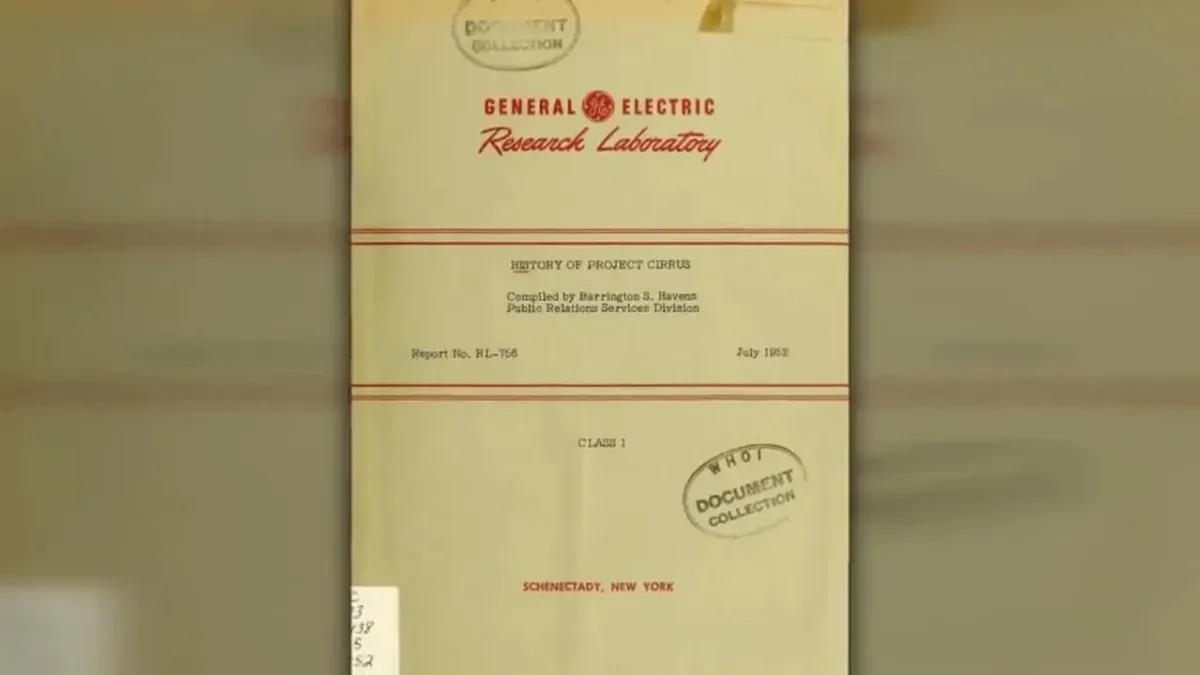 Photo: Project Cirrus, via thumbnails.odycdn.com
 Photo: Irving Langmuir, via cdn.quotesgram.com
 Photo: Vincent Schaefer, via weathermodificationhistory.com
The federal government, never one to miss a chance to throw taxpayer money at an impossible dream, jumped aboard with both feet. By the 1960s, the U.S. Weather Bureau was running rain-making programs across the American West like they were operating a celestial vending machine. Drop in some silver iodide, get out some precipitation. Simple as that.
When Science Fiction Became Science Policy
The sheer audacity of these predictions would make a cryptocurrency evangelist blush. Dr. Irving Krick, who somehow convinced himself he was the Steve Jobs of meteorology, promised that weather control would be "routine" by 1975. Not just possible—routine. Like checking your email or complaining about gas prices.
The U.S. Department of Agriculture got so swept up in the enthusiasm that they started planning agricultural policy around the assumption that farmers would soon be able to order rain like room service. Drought-resistant crops? Who needs those when you can just dial up a thunderstorm?
Meanwhile, the military was having fever dreams about weaponizing weather control. Operation Popeye, the classified cloud-seeding program during the Vietnam War, represented the Pentagon's sincere belief that they could literally rain on the enemy's parade. Because nothing says "American ingenuity" like trying to win a war by making it drizzle more than usual.
The Reality Check That Never Bounced
Here's the thing about weather: it turns out to be slightly more complex than a 1960s government bureaucrat anticipated. Who could have predicted that atmospheric systems spanning thousands of miles might be resistant to human intervention?
Cloud seeding, the miracle technology that was supposed to end droughts forever, managed to increase precipitation by roughly 5-15% under ideal conditions. In meteorological terms, that's like bringing a water pistol to fight a forest fire. Useful? Maybe. Revolutionary? Only if your definition of revolution includes disappointing everyone who funded your research.
The hurricane modification programs were even more spectacular in their failure to deliver on promises. Project Stormfury, which ran from 1962 to 1983, spent two decades and millions of dollars trying to weaken hurricanes by seeding their eyewalls with silver iodide. The results were about as effective as trying to stop a freight train by throwing pebbles at it.
The Forecast for Humility
By 1990, the year when weather control was supposed to be as common as cable television, Americans were still canceling outdoor weddings because of unexpected rain. The National Weather Service had gotten remarkably good at telling us exactly when and where we were about to get soaked, but stopping the rain? That remained firmly in the realm of divine intervention.
The irony is delicious. While America's weather controllers were busy failing to tame Mother Nature, they accidentally created something far more valuable: the modern meteorological forecasting system. Today's weather predictions are so accurate that we take five-day forecasts for granted, something that would have seemed like pure magic to the cloud-seeding enthusiasts of the 1950s.
The Silver Lining in the Storm Clouds
The weather control prophets weren't completely wrong about everything. They correctly predicted that technology would revolutionize our relationship with weather—they just got the direction backwards. Instead of controlling the weather, we learned to predict it with stunning precision.
Modern Doppler radar, satellite imagery, and computer modeling have given us superpowers that the Project Cirrus scientists never imagined: the ability to see hurricanes coming days in advance, to track tornado formation in real-time, and to warn people about dangerous weather with enough lead time to actually save lives.
Sure, we can't schedule sunshine for your barbecue, but we can tell you exactly when to move it indoors. In the grand scheme of human achievement, that's not a bad consolation prize for failing to become the gods of the sky.
The next time you check your weather app and see a perfectly accurate seven-day forecast, remember the optimistic meteorologists who promised to control the heavens. They aimed for the stars and landed among the clouds—which, as it turns out, was exactly where we needed them to be.