The Highway to Nowhere (Slowly)
Every few years, like clockwork, some politician or transportation planner steps up to a podium, adjusts their tie, and declares with the confidence of someone who's never sat in I-405 traffic that they've found the silver bullet for America's commuting nightmare. This time, they insist, they've cracked the code. Whether it's monorails, personal rapid transit, smart highways, or Elon Musk's latest fever dream, the solution is always just one bold investment and a decade away from transforming your soul-crushing daily commute into a pleasant journey through transportation paradise.
Seventy years later, Americans are spending more time stuck in traffic than ever before, and the promises keep coming with undiminished enthusiasm.
The Original Sin: We'll Build Our Way Out
It all started so optimistically. In 1956, President Eisenhower signed the Interstate Highway Act, promising that a network of modern superhighways would eliminate traffic congestion in America's cities. Transportation Secretary Charles Wilson declared that the new interstates would "end the daily traffic nightmare" by 1970.
The highways got built. Traffic got worse. Turns out, when you make it easier to drive somewhere, more people drive there. Who could have predicted such a thing? (Well, actually, several urban planners did, but nobody listened to them.)
The Monorail Fever Dreams of the 1960s
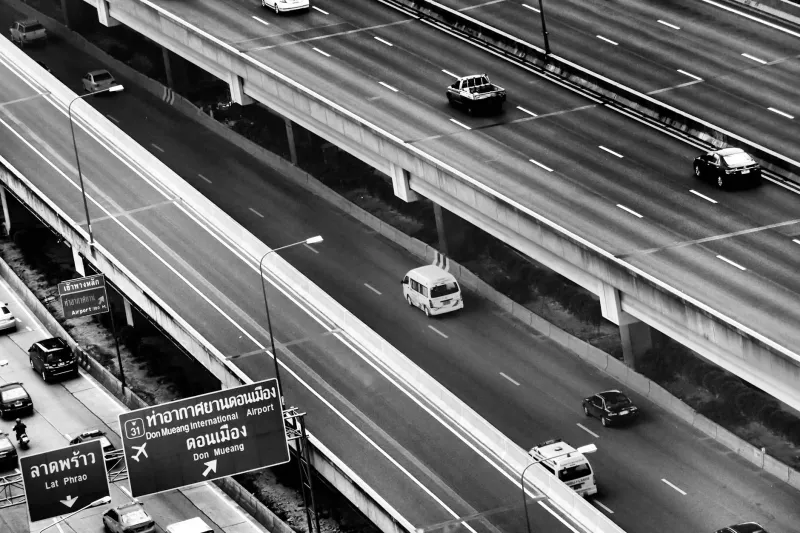
By the 1960s, with traffic getting worse instead of better, transportation visionaries pivoted to elevated solutions. Literally. Monorails became the answer to everything, promising to whisk commuters above the gridlock in sleek, silent pods.
Seattle built one for the 1962 World's Fair, and suddenly every city wanted its own elevated people-mover. Politicians from Los Angeles to Detroit promised monorail networks that would revolutionize urban transportation. "By 1980," proclaimed one particularly optimistic Los Angeles transportation commissioner, "monorails will make the automobile as obsolete as the horse and buggy."
Seattle still has its monorail. It goes from downtown to the Space Needle – all of 1.2 miles. Los Angeles is still building its subway system, having discovered that tunneling under a city built on fault lines presents certain engineering challenges that 1960s optimism couldn't overcome.
The Personal Rapid Transit Revolution That Wasn't
The 1970s brought Personal Rapid Transit (PRT) – small automated pods that would provide on-demand transportation without the hassle of schedules or other passengers. West Virginia University actually built one, and politicians across the country hailed it as the future of urban mobility.
"PRT will eliminate the need for private automobiles in cities," declared a Department of Transportation study in 1975. "By 1990, most Americans will commute via automated pod networks."
West Virginia's PRT system still operates, carrying students around campus. It's been broken down for maintenance roughly 40% of the time since it opened, which turns out to be a pretty good metaphor for most transportation predictions.
The Smart Highway Mirage
The 1990s brought the promise of "Intelligent Transportation Systems" – smart highways that would use computers and sensors to optimize traffic flow and eliminate congestion. The Federal Highway Administration launched a massive program promising that electronic guidance systems would increase highway capacity by 300% without building new roads.
"Traffic jams will be a thing of the past by 2010," confidently predicted the program's director. "Smart highways will coordinate vehicle movements with military precision."
We got electronic toll collection and variable message signs that tell us our commute will take 47 minutes instead of the usual 45. The precision turned out to be more like military intelligence – occasionally accurate, often optimistic, always expensive.
High-Speed Rail: Europe Does It, Why Can't We?
For decades, politicians have promised that high-speed rail would transform American transportation, pointing to successful systems in Europe and Asia. California broke ground on its high-speed rail project in 2015, with Governor Jerry Brown promising trains would connect Los Angeles to San Francisco by 2020.
As of 2024, California has built about 100 miles of track in the Central Valley – connecting Bakersfield to Merced, which is roughly like building a bridge from nowhere to anywhere. The project is now projected to cost $100 billion and maybe, possibly, potentially be completed sometime after the sun burns out.
The Hyperloop Hype Cycle
Just when it seemed like transportation promises couldn't get more ambitious, along came Elon Musk with the hyperloop – pods shooting through vacuum tubes at 600 mph. Politicians and tech enthusiasts declared it the ultimate solution to both traffic congestion and long-distance travel.
"The hyperloop will make conventional transportation obsolete," proclaimed various tech evangelists around 2015. "By 2025, you'll commute from Los Angeles to San Francisco in 30 minutes."
Several hyperloop companies have built test tracks and demonstrated that yes, you can shoot a pod through a tube very fast. Whether you can do it safely, affordably, or practically remains an open question that physics seems oddly reluctant to answer.
The Autonomous Vehicle Salvation
The latest transportation messiah is the autonomous vehicle. Self-driving cars, we're told, will eliminate traffic by coordinating perfectly, reduce the need for parking, and allow commuters to be productive during their journey instead of white-knuckling the steering wheel.
"Full self-driving capability will solve traffic congestion within five years," various tech CEOs have predicted annually since about 2015. Each year, the timeline gets pushed back another five years, like a technological version of Groundhog Day.
The Uncomfortable Truth About Traffic
Here's what seventy years of failed predictions have taught us: traffic isn't really a technology problem. It's a math problem. When you have millions of people who need to be in roughly the same places at roughly the same times, using roughly the same routes, you get congestion. No amount of technological wizardry changes the fundamental equation of too many people, not enough space, same schedule.
Every solution that's actually worked – carpooling, staggered work hours, remote work, congestion pricing – involves changing human behavior, not building new gadgets. But changing behavior is hard, and politicians prefer promising shiny new toys that will solve everything without requiring anyone to modify their lifestyle.
The Eternal Optimism
The remarkable thing about transportation predictions isn't how wrong they've been – it's how consistently optimistic they remain. Each new generation of planners and politicians looks at the failures of the past and thinks, "Those people just didn't have the right technology. We'll get it right this time."
Maybe they will. Maybe quantum tunneling or teleportation or trained dolphins will finally solve the traffic problem. But based on seventy years of evidence, it's probably safer to assume that your commute tomorrow will look a lot like your commute today, just with slightly more expensive gas and maybe a few more potholes.
In the meantime, at least you'll have plenty of time to think about it while you're sitting in traffic, listening to another politician promise that relief is just around the corner. Or in this case, just past the next exit, where construction has reduced four lanes to one and the estimated delay is... longer than the original trip was supposed to take.