When Speed Was Everything
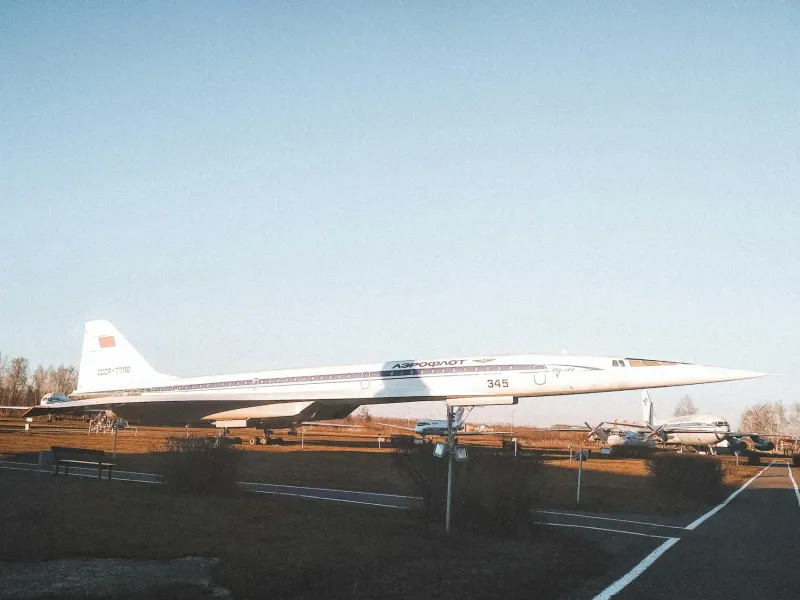
In 1976, the Concorde touched down at Dulles Airport with all the fanfare of a moon landing. Politicians posed for photos, champagne flowed, and aviation experts lined up to explain why this gleaming needle of French and British engineering was just the appetizer. The main course? A fleet of American supersonic transports that would make the Concorde look like a covered wagon.
 Photo: Dulles Airport, via www.tedisgraphic.com
Boeing's abandoned SST project might have crashed and burned in Congress, but that didn't stop the aviation prophets from doubling down. By 1990, they promised, supersonic flight would be as routine as catching a Greyhound to Pittsburgh.
The Gospel According to Aerospace
The predictions came fast and furious from every corner of the industry. NASA administrators testified before Congress that supersonic passenger service would "revolutionize air travel within the decade." Boeing executives, still smarting from their SST cancellation, insisted they were just temporarily sidelined—American supersonic jets would dominate the skies by the mid-1980s.
The Federal Aviation Administration got in on the action too, publishing studies that projected hundreds of supersonic routes crisscrossing American airspace. Los Angeles to New York in 90 minutes. Miami to Seattle before your morning coffee got cold. The bureaucrats had it all mapped out, complete with new air traffic control procedures for the supersonic highway in the sky.
Even the economists joined the chorus. Aviation Week published breathless analyses showing how economies of scale would drive supersonic ticket prices down to "competitive levels" with conventional jets. One particularly optimistic Rand Corporation study suggested that by 1995, supersonic flights might actually cost less than regular airfare.
Reality's Inconvenient Arithmetic
Turns out the aviation visionaries had overlooked a few tiny details. Like the fact that the Concorde burned fuel like a Saturn V rocket and cost more per seat-mile than chartering a private yacht. Or that most passengers, given the choice between arriving three hours faster and paying three times more, consistently chose their wallets over their watches.
The noise problem proved equally stubborn. Those sonic booms that sounded so thrilling in test footage? Less charming when they rattled windows across suburban America twice a day. The FAA banned supersonic flight over land faster than you could say "class action lawsuit."
Then there was the small matter of building the planes. Boeing's projected costs for a new SST kept climbing like a rocket ship, while projected passenger demand kept falling like a brick. By 1980, even the most optimistic aerospace executives were quietly pushing their supersonic timeline into the "next decade."
The Concorde's Lonely Victory Lap
Meanwhile, the Concorde soldiered on as aviation's most beautiful money pit. British Airways and Air France kept their fleets flying for 27 years, serving a tiny but devoted clientele willing to pay Manhattan rent prices for the privilege of crossing the Atlantic in three and a half hours.
The planes themselves were marvels of engineering—delta-winged sculptures that could cruise at Mach 2.04 while their passengers sipped champagne and watched the Earth's curvature through tiny windows. But marvelous engineering doesn't automatically translate to profitable aviation, a lesson the industry seemed determined to learn the hard way.
When the Music Stopped
The final nail in the supersonic coffin came from an unexpected source: the 2000 Air France Flight 4590 crash in Paris. A piece of metal on the runway punctured a fuel tank, and suddenly the Concorde's safety record was front-page news. Passenger bookings, already anemic after 9/11, collapsed entirely.
By 2003, both airlines threw in the towel. The last commercial Concorde flight landed at Heathrow on October 24, 2003, ending the supersonic passenger era with all the ceremony of a funeral procession.
The Next Generation of Prophets
Naturally, this hasn't stopped a new generation of aviation seers from making equally bold predictions. Boom Supersonic promises to have paying passengers airborne by 2029. SpaceX talks about point-to-point rocket travel. NASA's working on "quiet" supersonic technology that might actually be allowed over land.
The promotional materials look remarkably similar to those glossy brochures from 1976, complete with sleek aircraft renderings and confident timelines. The only difference? This time, they promise, they've really figured out the economics.
The Speed We Actually Got
While aviation experts spent decades chasing Mach 2, the airline industry found a different kind of efficiency. Modern jets like the Boeing 787 and Airbus A350 might cruise at a leisurely 560 mph, but they carry twice as many passengers as the Concorde while burning half the fuel per seat.
The result? International air travel became genuinely affordable for the masses, even if it didn't happen at the speed of sound. Turns out most passengers preferred paying $800 for an eight-hour flight over $8,000 for a four-hour one.
Today, you can fly from New York to London for less than the price of a decent hotel room, though you'll need to pack your patience along with your passport. The aviation prophets delivered their promised revolution—they just got the details spectacularly, expensively wrong.