The Original Suburban Obituary
In 1973, as Americans were dealing with gas lines and wondering if their Buicks would become lawn ornaments, urban planning expert James Howard Kunstler looked at the sprawling subdivisions of America and saw death. Not metaphorical death — actual, literal, inevitable death.
 Photo: James Howard Kunstler, via substackcdn.com
The suburbs, Kunstler declared with the confidence of a man who'd never had to mow a lawn, were "the greatest misallocation of resources in the history of the world." Energy crises would make them uninhabitable. Economic reality would make them unaffordable. Americans would abandon their split-levels and ranch houses faster than they'd abandoned downtown Detroit.
It was a beautiful theory, supported by impeccable logic and absolutely zero understanding of what Americans actually wanted.
Kunstler wasn't alone in his suburban death watch. Academic journals filled with papers predicting the imminent collapse of suburbia. The oil shocks of the 1970s would force Americans back into dense, walkable cities. The suburban experiment was over before it really began.
Except Americans kept buying houses in subdivisions, and those subdivisions kept sprawling across the landscape like kudzu in Georgia.
The Back-to-the-City Movement (That Mostly Stayed Put)
The 1980s brought a new wave of suburban skepticism, this time dressed up as sophisticated urban theory. Gentrification was transforming American cities, and suddenly living downtown was cool again. Young professionals were abandoning suburban shopping malls for urban loft apartments.
Urban planners proclaimed the dawn of a new era. Americans were finally coming to their senses about suburban living. Cities offered culture, walkability, and freedom from the soul-crushing conformity of subdivision life.
Architectural critics like Ada Louise Huxtable wrote suburban obituaries with the flourish of poets. The suburb was "a mess of unrelated fragments," doomed to collapse under its own contradictions. Americans would soon realize that driving everywhere was unsustainable, both economically and spiritually.
 Photo: Ada Louise Huxtable, via snoopy.archdaily.com
Magazines like Metropolis and Dwell celebrated urban living with the evangelical fervor of missionaries spreading the good news. Suburbs weren't just unfashionable — they were morally wrong, environmentally destructive, and economically doomed.
Meanwhile, suburbs kept growing, and Americans kept moving to them in numbers that would have impressed the California Gold Rush.
The New Urbanism Revolution
The 1990s brought New Urbanism, and with it the most sophisticated anti-suburban argument yet mounted. Planners like Andrés Duany and Elizabeth Plater-Zyberk didn't just predict suburban death — they designed its replacement.
New Urbanist developments would combine the best of city and suburb: walkable neighborhoods with front porches, mixed-use development, and transit connections. Americans would finally abandon their car-dependent subdivisions for communities that actually made sense.
The movement attracted disciples like a prosperity gospel. Academic conferences celebrated the coming end of sprawl. Books like Suburban Nation explained why traditional suburban development was not just undesirable but literally unsustainable.
Celebration, Florida, became the movement's showcase — a Disney-designed community that proved Americans could live happily without two-car garages and cul-de-sacs. The future had arrived, and it looked like a Norman Rockwell painting with better public transportation.
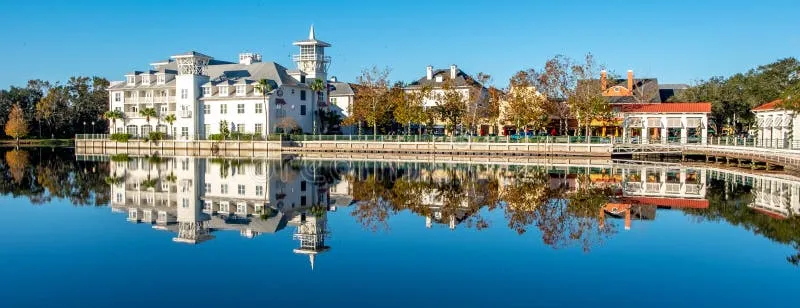 Photo: Celebration, Florida, via thumbs.dreamstime.com
Except most Americans took one look at New Urbanist developments and decided they'd rather have their McMansions and long commutes, thank you very much.
The Millennial Apocalypse
By the 2000s, suburban death predictions had found their perfect weapon: millennials. This generation, urban experts declared, was different. They wanted experiences, not stuff. They preferred cities to suburbs. They would rather take Uber than own cars.
Millennials were going to kill everything suburban America held dear: chain restaurants, department stores, golf courses, and eventually the suburbs themselves. Raised on social media and environmental consciousness, they would reject the wasteful sprawl of their parents' generation.
Urban planners practically salivated over demographic projections showing millennials flocking to cities. Finally, generational change would accomplish what economic and environmental arguments had failed to achieve: the death of suburbia.
Real estate experts predicted the coming collapse of suburban home values. Who would buy all those oversized houses when millennials preferred urban apartments? The suburban housing stock would become worthless, leaving baby boomers stranded in communities nobody wanted.
It was a beautiful theory, right up until millennials started getting married, having kids, and suddenly discovering that urban apartments weren't big enough for car seats and strollers.
The 2008 Reality Check
The housing crisis of 2008 seemed to validate every suburban death prediction ever made. Foreclosure signs sprouted in subdivisions like dandelions. McMansions sat empty. Suburban development ground to a halt.
Urban experts declared victory with the restraint of touchdown dancers in the Super Bowl. Suburbia had finally collapsed under its own excess. Americans would learn to live within their means in dense, sustainable communities.
The Atlantic published articles with titles like "The End of the Suburbs." Academic papers celebrated the "right-sizing" of American housing expectations. The suburban dream had become the suburban nightmare, and Americans were finally waking up.
Except the housing crisis hit cities just as hard as suburbs, and when recovery came, Americans went right back to buying houses in subdivisions, just like they always had.
The Millennial Homebuying Surprise
Somewhere around 2015, something funny happened to the millennial generation that was supposed to kill suburbia: they started buying suburban houses. Turns out that wanting walkable neighborhoods and good schools wasn't mutually exclusive with wanting a yard and a two-car garage.
Millennials discovered what every previous generation had learned: cities are great for your twenties, but suburbs are where you raise kids. Urban apartments that seemed charmingly cozy at 25 felt claustrophobic at 35 with a toddler and a dog.
The same millennials who had supposedly rejected car ownership were suddenly shopping for SUVs. The generation that preferred experiences to stuff discovered that stuff like washing machines and storage space were actually pretty useful.
Urban planners watched in horror as their supposed suburban-killers became suburban buyers, bidding up house prices in subdivision after subdivision.
COVID's Plot Twist
Then 2020 happened, and suddenly every prediction about suburban death looked not just wrong but spectacularly backwards. When Americans could work from anywhere, they didn't choose dense urban apartments — they chose suburban houses with home offices and backyards.
The great urban exodus made the 1950s suburban migration look like a gentle stroll. City residents fled to suburbs and small towns in numbers that shocked demographers. Home prices in suburban markets exploded as urban refugees bid against each other for houses with driveways and lawns.
San Francisco lost population. New York lost population. Los Angeles lost population. Meanwhile, suburban markets from Boise to Austin saw bidding wars that would have made dot-com speculators blush.
The experts who had spent decades predicting suburban death suddenly found themselves explaining why everyone was moving to suburbs. Remote work had changed everything. Americans had rediscovered the value of space. The pandemic had revealed the hidden costs of urban density.
The Eternal Suburban Phoenix
As Americans adapt to post-pandemic life, urban experts are already crafting new suburban death predictions. Climate change will make sprawl impossible. Gas prices will force consolidation. Generation Z will definitely, finally, really reject suburban living.
Meanwhile, suburban developers can't build houses fast enough to meet demand. Americans are moving to suburbs in record numbers, driving prices to levels that would have seemed impossible just a few years ago.
The pattern is so predictable it's almost comical: experts predict suburban death, Americans buy more suburban houses, experts explain why this time is different, repeat.
The truth is that suburban death predictions tell us more about the people making them than about American housing preferences. Urban planners want Americans to live in walkable communities because they think walkable communities are better. Economists want Americans to live in dense cities because they think dense cities are more efficient.
Americans, it turns out, want houses with yards, good schools, and parking spaces, regardless of what experts think they should want.
The Prophecy That Won't Die
Somewhere right now, an urban planning professor is probably writing a paper explaining why suburbia is finally, definitely, really doomed this time. Climate change, demographic shifts, economic pressures — something will surely convince Americans to abandon their foolish attachment to single-family houses and two-car garages.
The suburbs have survived energy crises, economic crashes, generational change, and global pandemics. They've outlasted every expert prediction of their demise.
But the experts keep predicting, and Americans keep moving to suburbs, creating one of the most reliable patterns in modern American life: the eternal suburban death watch that never quite manages to watch suburbia actually die.
The prophets were wrong about suburban death, but they'll be back with new predictions, new theories, and the same old confidence that this time, Americans will finally come to their senses.
Meanwhile, somewhere in America, a young couple is probably touring a house in a subdivision, checking out the two-car garage and wondering if the HOA allows trampolines.